
Single-cell sequencing has transformed molecular biology by allowing researchers to examine genetic and transcriptional variation at the level of individual cells rather than population averages. Traditional bulk sequencing approaches mask cellular heterogeneity, while single-cell workflows reveal subtle biological differences, rare subpopulations, clonal diversity, transcriptional dynamics, and pathway-specific activation states.
A Single Cell Sequence Specific Amplification Kit is designed to enhance the sensitivity, precision, and efficiency of targeted single-cell sequencing experiments. Instead of amplifying entire genomes or transcriptomes indiscriminately, this approach focuses amplification on predefined sequences of interest, dramatically increasing useful read depth and improving reproducibility for hypothesis-driven studies.
This educational article explores the scientific background, technical principles, workflow integration, applications, optimization strategies, and long-term research value of sequence-specific amplification in single-cell genomics — written in a clean, research-focused style suitable for academic and laboratory blogs.
The Scientific Context of Single-Cell Sequencing
Single-cell sequencing has become a foundational method in molecular biology research. By isolating individual cells prior to nucleic acid amplification, researchers can:
-
Characterize cell-to-cell variability
-
Detect rare transcripts or low-frequency variants
-
Explore differentiation trajectories
-
Map transcriptional networks
-
Study mosaicism and clonal evolution
Comprehensive methodological overviews are available through educational and government resources such as:
-
National Center for Biotechnology Information (NCBI):
https://www.ncbi.nlm.nih.gov/ -
NCBI Bookshelf – Single-Cell RNA Sequencing Procedures:
https://www.ncbi.nlm.nih.gov/books/NBK569559/ -
National Human Genome Research Institute (NHGRI):
https://www.genome.gov/ -
NIH Single-Cell Sequencing Core Overview:
https://www.nia.nih.gov/research/labs/card-single-cell-sequencing-core -
Review of single-cell RNA sequencing technologies (NIH PMC):
https://pmc.ncbi.nlm.nih.gov/articles/PMC8964935/
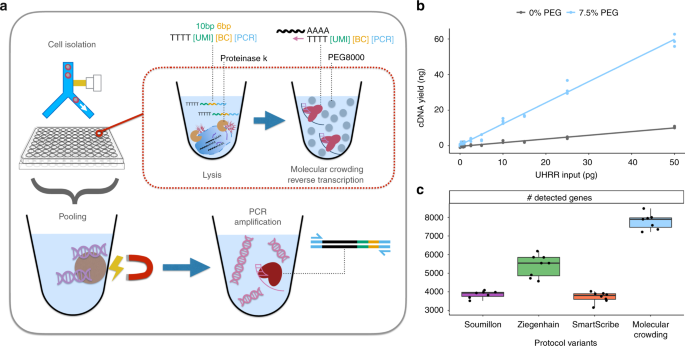
Single-cell approaches typically involve:
-
Cell isolation
-
Lysis and nucleic acid extraction
-
Reverse transcription (for RNA workflows)
-
Amplification
-
Library preparation
-
Sequencing
-
Bioinformatic analysis
The amplification step is critical because a single cell contains only picogram quantities of nucleic acids. Without efficient amplification, signal loss and dropout occur frequently.
Why Sequence-Specific Amplification Matters
Many single-cell experiments begin with a discovery-driven, whole-transcriptome or whole-genome approach. However, once targets are identified, researchers often transition to focused validation, pathway studies, or high-throughput screening designs.
Sequence-specific amplification offers several advantages:
Concentrated Sequencing Depth
Instead of distributing reads across tens of thousands of genes, targeted amplification directs sequencing capacity toward selected regions.
Reduced Data Sparsity
Single-cell datasets frequently contain “zero-inflated” matrices due to dropout events. Target enrichment improves detection rates for predefined targets.
Cost Efficiency
Focusing on specific loci allows more samples or more cells to be analyzed within the same sequencing budget.
Improved Reproducibility
Targeted panels reduce variability associated with stochastic transcript loss.
Educational background on single-cell sparsity and analysis principles can be explored at:
-
PubMed Single-Cell RNA-Seq Analysis Review:
https://pubmed.ncbi.nlm.nih.gov/33835452/ -
NLM (National Library of Medicine):
https://www.nlm.nih.gov/
Core Principle of a Single Cell Sequence Specific Amplification Kit
A Single Cell Sequence Specific Amplification Kit is engineered to selectively amplify predefined nucleic acid sequences from individual cell lysates or cDNA.
Depending on kit configuration, this may involve:
-
Multiplex PCR-based amplification
-
Targeted amplicon enrichment
-
Nested amplification designs
-
Adapter-linked primer strategies
-
Indexed primer sets compatible with NGS
The chemistry is optimized for:
-
Extremely low input material
-
High specificity
-
Minimal off-target amplification
-
Uniform amplification across targets
Foundational understanding of amplification and single-cell genome analysis is discussed by:
-
NHGRI: The Power of Sequencing Single-Cell Genomes
https://www.genome.gov/27552295/gaotm-the-power-of-sequencing-single-cell-genomes -
PubMed: Whole-Genome Amplification Using MDA
https://pubmed.ncbi.nlm.nih.gov/17487184/

Integration into Modern Single-Cell Workflows
A typical workflow using a sequence-specific amplification kit may include:
-
Single-cell isolation (FACS, droplet microfluidics, microwells, LCM)
-
Lysis and nucleic acid release
-
Reverse transcription (for RNA targets)
-
Targeted amplification using the kit
-
Indexing and library preparation
-
NGS sequencing
-
Target-focused analysis
For educational insights into genomics infrastructure and laboratory best practices, see:
-
UCSF Genomics Core:
https://genomics.ucsf.edu/ -
Harvard Department of Stem Cell and Regenerative Biology:
https://hscrb.harvard.edu/ -
Stanford Genetics Department:
https://med.stanford.edu/genetics.html -
MIT Department of Biology:
https://biology.mit.edu/ -
UC Berkeley Molecular & Cell Biology:
https://mcb.berkeley.edu/ -
Johns Hopkins Genomics:
https://www.hopkinsmedicine.org/research/
Applications in Research
A Single Cell Sequence Specific Amplification Kit supports a wide range of advanced molecular biology applications.
Targeted Gene Expression Panels
Focused evaluation of transcription factors, pathway components, receptor families, or regulatory genes across heterogeneous cell populations.
Rare Cell Subpopulation Analysis
Detection of markers expressed in very small subsets of cells.
Variant-Focused Single-Cell DNA Studies
Amplification of predefined loci for mutation tracking, mosaic analysis, or clonal structure investigation.
CRISPR Editing Assessment
Target-specific amplification enables evaluation of editing outcomes at the single-cell level.
Isoform and Splice Variant Investigation
Sequence-specific primers can distiathway-Focused Research
Pathway-Focused Research
Signaling cascades, stress response modules, developmental markers.
Key Technical Advantages
When evaluating or presenting a Single Cell Sequence Specific Amplification Kit, highlight:
-
High sensitivity from picogram input
-
Uniform amplification efficiency
-
Reduced amplification bias
-
Multiplex compatibility
-
Optimized enzyme system
-
Low background noise
-
NGS-ready workflow compatibility
-
Scalable panel design
Researchers searching for such kits often use high-intent terms such as:
-
targeted single-cell sequencing
-
single-cell PCR panel
-
multiplex single-cell amplification
-
low-input DNA amplification kit
-
single-cell amplicon sequencing
-
rare transcript detection single cell
Integrating these naturally within content improves discoverability without compromising readability.

Best Practices for Optimal Results
Cell Quality
-
Maintain high cell viability where applicable
-
Use gentle dissociation methods
-
Minimize freeze-thaw cycles
Clean Handling
-
RNase/DNase-free conditions
-
Proper reagent storage
Controls
-
No-template controls
-
Positive control nucleic acids
-
Replicate experiments
Panel Design Considerations
-
Balanced primer melting temperatures
-
Amplicon length optimization
-
Avoidance of secondary structures
Data Analysis Considerations
Targeted single-cell datasets are often easier to interpret compared to whole-transcriptome experiments because:
-
Read depth per target is higher
-
Noise from irrelevant genes is reduced
-
Statistical modeling is simplified
For broader background on genomic data analysis:
-
National Institute on Aging Research Resources:
https://www.nia.nih.gov/ -
National Human Genome Research Institute:
https://www.genome.gov/about-nhgri -
National Library of Medicine Genomics Resources:
https://www.nlm.nih.gov/
Long-Term Research Value
As single-cell technologies continue evolving, targeted amplification remains highly relevant because:
-
Discovery studies generate candidate genes
-
Follow-up studies require validation
-
Large-scale screens need focused panels
-
Comparative studies benefit from consistent targets
A robust Single Cell Sequence Specific Amplification Kit becomes a core tool for:
-
Academic laboratories
-
Core facilities
-
Method development groups
-
High-throughput screening platforms
-
Systems biology research
Scientific Foundation and Credible References
Researchers seeking deeper methodological context can consult:
-
NIH PMC Review of Single-Cell RNA-Seq Technologies:
https://pmc.ncbi.nlm.nih.gov/articles/PMC8964935/ -
Smart-seq2 Single-Cell RNA-Seq Protocol:
https://pmc.ncbi.nlm.nih.gov/articles/PMC7501729/ -
PubMed Review on Single-Cell Transcriptomics:
https://pubmed.ncbi.nlm.nih.gov/37321420/ -
PubMed Whole-Genome Amplification Study:
https://pubmed.ncbi.nlm.nih.gov/17487184/ -
NCBI Home:
https://www.ncbi.nlm.nih.gov/ -
NHGRI Educational Resources:
https://www.genome.gov/
Conclusion
A Single Cell Sequence Specific Amplification Kit represents a precision-focused solution within the rapidly expanding field of single-cell genomics. By concentrating amplification on defined targets, researchers gain:
-
Greater sensitivity
-
More efficient sequencing utilization
-
Improved reproducibility
-
Stronger hypothesis-driven clarity
-
Reduced data complexity
As laboratories increasingly transition from discovery-scale experiments to validation and pathway-specific investigations, targeted single-cell amplification strategies continue to provide measurable technical and analytical advantages.