
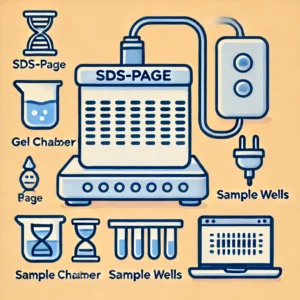
The LDS (Lithium Dodecyl Sulfate) Sample Loading Buffer, 4X is a critical reagent used extensively in SDS-PAGE (Sodium Dodecyl Sulfate-Polyacrylamide Gel Electrophoresis) for the separation of proteins. This buffer facilitates the proper denaturation and preparation of protein samples, ensuring accurate results in molecular biology research. Understanding its components and applications is essential for successful protein analysis.
Composition and Function
The LDS Sample Loading Buffer, 4X, typically comprises:
- Lithium Dodecyl Sulfate (LDS): This anionic detergent denatures proteins and imparts a uniform negative charge, essential for size-based separation NCBI.
- Tris-HCl: Maintains the pH of the buffer, promoting protein stability during electrophoresis. For more on the properties of buffers, see NIST.
- Glycerol: Adds density, helping samples sink smoothly into the wells NIH.
- Dye (e.g., Bromophenol Blue): Provides a visible marker to monitor the progress of electrophoresis CDC.
- Reducing Agents (e.g., DTT or β-mercaptoethanol): These agents break disulfide bonds in proteins, ensuring complete denaturation. Learn about reducing agents at FDA.
Key Applications
The LDS Sample Loading Buffer is indispensable for various biochemical and research procedures:
- Protein Electrophoresis: Facilitates the accurate separation of proteins by molecular weight, allowing researchers to identify and analyze proteins effectively. Visit NIAID for more on protein electrophoresis techniques.
- Western Blotting: Ensures proteins remain denatured and allows for efficient transfer to membranes for immunodetection. For blotting methods, refer to NIEHS.
- Protein Size and Purity Analysis: Critical in research that requires assessment of protein integrity. More about protein assays can be found at USDA.
Benefits of Using LDS Sample Loading Buffer
- Consistent Denaturation: The buffer’s formulation ensures proteins are uniformly denatured and prepared for electrophoresis. For denaturation methods, see DOE Office of Science.
- High Compatibility: The buffer can be used with a range of proteins, including membrane proteins, enhancing its applicability. Explore further applications at NSF.
- Reliable Results: Provides clear and reproducible outcomes, essential for comparative studies and quantitative analysis. For data reproducibility standards, check NIST.
Detailed Protocols
For reliable use of the LDS Sample Loading Buffer, 4X, standard laboratory protocols recommend:
- Dilution to 1X Concentration: Mix with protein samples in appropriate ratios before loading onto the gel. Detailed dilution instructions can be found at NIH.
- Heating: Heating the sample-buffer mixture (e.g., 70–95°C) for several minutes ensures thorough protein denaturation. Learn more at NLM.
- Storage: Store the buffer at 4°C or freeze for long-term stability, as outlined by FDA guidelines.

Advanced Research Insights
The LDS Sample Loading Buffer has been pivotal in research involving protein structures, interactions, and functions:
- Neuroscience Research: Used to study brain-specific proteins in diseases like Alzheimer’s Alzheimers.gov.
- Cancer Studies: Helps identify cancer biomarkers through protein profiling. Explore more on cancer research at Cancer.gov.
- Immunology: Integral in analyzing proteins associated with immune response. For immunology-related studies, refer to NIAID.
Conclusion
The LDS Sample Loading Buffer, 4X is an essential reagent for any laboratory performing protein analysis. Its comprehensive composition, broad application, and reliable results make it a valuable tool for researchers studying protein expression, function, and interaction. For more detailed research protocols and applications, visit academic resources such as Harvard University, MIT, and Stanford University.