
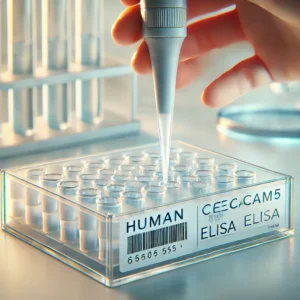
The Human CEACAM5 ELISA Kit is a highly sensitive and specific assay designed for the detection and quantification of CEACAM5 (Carcinoembryonic Antigen-Related Cell Adhesion Molecule 5) in various biological samples, including serum, plasma, and cell culture supernatants. CEACAM5 is a widely studied biomarker due to its association with various cancers, particularly colorectal, lung, and pancreatic cancers. This article explores the significance of CEACAM5, the applications of its ELISA kit, and its role in advancing cancer diagnostics and research.
What is CEACAM5?
CEACAM5, also known as Carcinoembryonic Antigen (CEA), is a glycoprotein that belongs to the CEACAM family. It plays a role in cell adhesion and immune response and is highly expressed in certain tumors, making it a key biomarker for cancer detection and monitoring.
For detailed insights into CEACAM5’s structure and function, visit the National Center for Biotechnology Information (NCBI) or PubMed.

Clinical Significance of CEACAM5
1. Cancer Detection
CEACAM5 is a well-established biomarker for the diagnosis and monitoring of various cancers, including:
- Colorectal Cancer: Elevated levels of CEACAM5 are strongly associated with colorectal cancer progression. Read more at the American Cancer Society.
- Lung Cancer: CEACAM5 can aid in diagnosing non-small cell lung cancer (NSCLC). Find detailed information at the National Cancer Institute (NCI).
- Pancreatic Cancer: CEACAM5 serves as a potential marker for pancreatic adenocarcinoma, as outlined by the Pancreatic Cancer Action Network.
2. Monitoring Disease Progression
Regular measurement of CEACAM5 levels can help assess disease progression and therapeutic response in cancer patients. Guidelines for cancer biomarker use can be found at FDA Biomarker Qualification Program.
3. Evaluating Treatment Efficacy
CEACAM5 is used to monitor the effectiveness of cancer therapies, including chemotherapy and immunotherapy.
Applications of the Human CEACAM5 ELISA Kit
The Human CEACAM5 ELISA Kit has diverse applications in research and clinical settings:
1. Cancer Research
The kit is used to investigate the role of CEACAM5 in cancer biology, including its involvement in tumor growth, metastasis, and immune evasion. Explore ongoing cancer research projects at NIH Cancer Research.
2. Drug Development
Researchers use the kit to evaluate the effect of novel anti-cancer drugs on CEACAM5 levels. For details on drug development processes, visit ClinicalTrials.gov.
3. Diagnostic Tool Development
The kit aids in developing new diagnostic assays for cancers associated with elevated CEACAM5 levels. Learn more about assay development at NIST.
4. Translational Medicine
By bridging basic science and clinical practice, the kit facilitates research that translates into improved patient care.

Features of the Human CEACAM5 ELISA Kit
- High Sensitivity and Specificity: Ensures accurate detection of CEACAM5 in biological samples, minimizing cross-reactivity.
- Wide Dynamic Range: Allows for the measurement of CEACAM5 across a broad concentration range.
- User-Friendly Protocol: Includes pre-coated plates, ready-to-use reagents, and a straightforward procedure.
- Compatible with Various Sample Types: Validated for serum, plasma, and cell culture supernatants.
- Quantitative Results: Provides precise and reproducible measurements for CEACAM5 levels.
How the CEACAM5 ELISA Kit Works
The enzyme-linked immunosorbent assay (ELISA) is a widely used method for detecting and quantifying proteins. The CEACAM5 ELISA follows these key steps:
- Coating: The microplate is pre-coated with an antibody specific to CEACAM5.
- Sample Addition: Biological samples containing CEACAM5 are added to the plate.
- Binding: CEACAM5 binds to the capture antibody.
- Detection: A secondary antibody, conjugated to an enzyme, binds to CEACAM5.
- Signal Development: A substrate reacts with the enzyme to produce a colorimetric signal, which is measured to determine CEACAM5 concentration.
For more details on ELISA methodology, refer to the NIH Assay Guidance Manual.
Advantages of Using the Human CEACAM5 ELISA Kit
- Rapid Results: The assay can be completed within a few hours, providing timely data for clinical and research needs.
- Reproducibility: Ensures consistent results across multiple experiments.
- Scalability: Suitable for both small-scale research and high-throughput screening.
- Cost-Effective: Provides an affordable alternative to other diagnostic methods, such as imaging and molecular diagnostics.
Challenges and Future Directions
1. Standardization
Variability in CEACAM5 cutoff values between laboratories highlights the need for standardization. Efforts to standardize biomarkers are led by organizations like the World Health Organization (WHO).
2. Emerging Technologies
Complementary technologies like proteomics and multiplex assays are being developed to enhance biomarker detection. Learn more at NIH Proteomics Research.
3. Expanding Applications
Future research may uncover new roles for CEACAM5 in other diseases, broadening its diagnostic and therapeutic potential.
Conclusion
The Human CEACAM5 ELISA Kit is a vital tool in cancer diagnostics and research, enabling the accurate measurement of CEACAM5 levels in biological samples. Its applications span basic research, clinical diagnostics, and drug development, making it an indispensable resource for scientists and clinicians alike.
For additional resources, visit: