
In the realm of molecular biology, antibodies are invaluable tools used to identify, locate, and quantify specific proteins, making them essential in a variety of experimental applications. The Goat anti-BFP Polyclonal IgG Antibody is a powerful and versatile product that plays a crucial role in the study of gene expression, protein localization, and cell biology. This comprehensive guide will walk through the characteristics, benefits, scientific applications, and research importance of this antibody, while ensuring SEO optimization for enhanced online visibility.
What Is the Goat anti-BFP Polyclonal IgG Antibody?
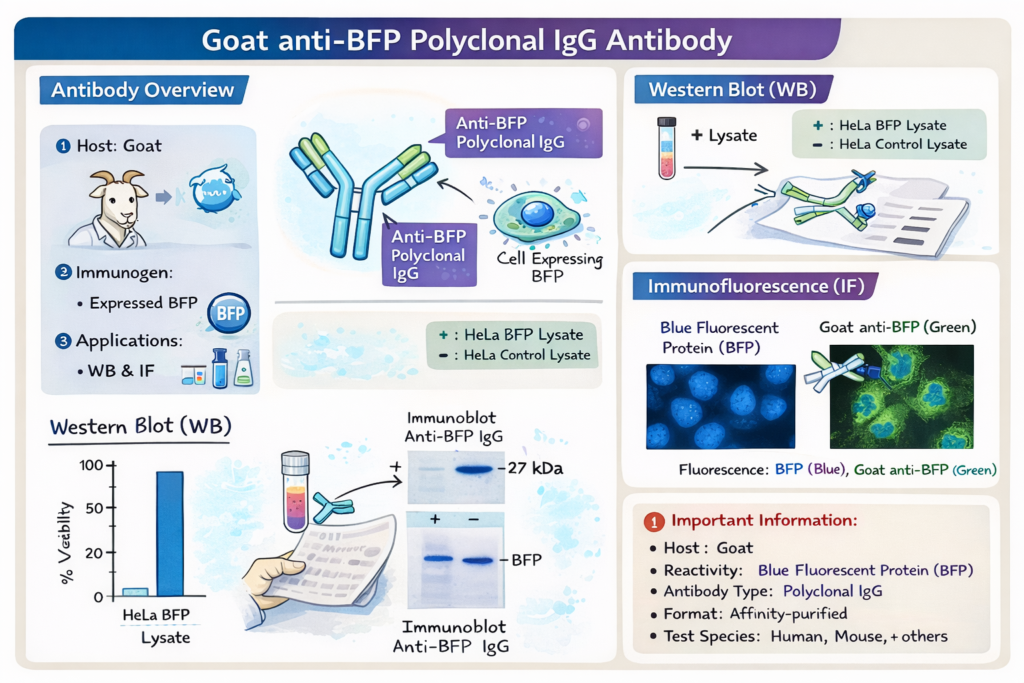
The Goat anti-BFP Polyclonal IgG Antibody is a high-quality antibody developed to specifically target the Blue Fluorescent Protein (BFP), which is commonly used as a reporter protein in molecular biology experiments. BFP, a fluorescent protein derived from the Aequorea victoria jellyfish, emits blue fluorescence when exposed to ultraviolet or blue light, making it an ideal marker for tracking gene expression and protein localization in live cells and tissue samples.
Polyclonal antibodies, like the Goat anti-BFP Polyclonal IgG Antibody, are produced by immunizing goats with the target antigen—in this case, the BFP protein—resulting in an immune response that generates a mixture of antibodies capable of recognizing multiple epitopes on the target. This provides several advantages, including higher sensitivity and more robust binding compared to monoclonal antibodies.
Key Features of the Goat anti-BFP Polyclonal IgG Antibody
-
High Specificity for BFP: The antibody is highly specific to BFP, ensuring minimal cross-reactivity with other proteins. This specificity is essential for achieving reliable and accurate experimental results, especially in complex biological samples.
-
Polyclonal Nature: As a polyclonal antibody, it is derived from multiple immune responses, allowing it to recognize several epitopes on the BFP molecule. This enhances the antibody’s binding affinity, leading to stronger and more consistent detection in assays.
-
Broad Application Range: The Goat anti-BFP Polyclonal IgG Antibody is suitable for a variety of laboratory techniques, such as:
-
Western Blotting: To detect BFP in protein extracts, confirming the presence of gene expression.
-
Immunofluorescence: For visualizing BFP expression in live cells or tissue sections using fluorescence microscopy.
-
Immunohistochemistry: To analyze the localization of BFP-tagged proteins in fixed tissues.
-
-
Customizable to Different Research Needs: This antibody can be easily integrated into diverse experimental setups, whether you are working with BFP-tagged recombinant proteins, gene expression vectors, or transfected cells.
-
Produced in Goats for High Affinity: Goats are chosen for antibody production due to their ability to generate robust immune responses, ensuring the antibodies have high binding affinity and specificity.
Advantages of Using Goat anti-BFP Polyclonal IgG Antibody
-
Enhanced Sensitivity: The polyclonal antibody recognizes multiple epitopes on BFP, making it more sensitive to detecting lower concentrations of the target protein in complex samples.
-
Reduced Background Noise: By specifically targeting the BFP protein, the antibody minimizes the detection of non-target proteins, reducing the background signal and increasing the overall quality of experimental results.
-
Cost-Effective Solution: Compared to monoclonal antibodies, polyclonal antibodies are often more affordable while still providing high performance in a variety of applications.
-
Proven Performance in Various Assays: The Goat anti-BFP Polyclonal IgG Antibody has been extensively tested to ensure reliable results in multiple experimental systems, including cell culture, tissue samples, and transgenic organisms.
-
Flexibility and Compatibility: Whether you’re working with fresh or fixed tissue, primary or secondary cells, or recombinant proteins, this antibody is compatible with a range of biological materials and assay formats.
Applications in Scientific Research
Antibodies like the Goat anti-BFP Polyclonal IgG Antibody are crucial for numerous fields of biological research, offering insights into protein behavior, gene regulation, and cellular processes. Below are some key areas where this antibody is widely used:
Gene Expression Analysis
BFP is commonly used as a reporter gene to monitor gene expression in cells. By fusing BFP to a gene of interest, researchers can easily track the expression levels of the target gene in real-time. The Goat anti-BFP Polyclonal IgG Antibody is an essential tool for detecting BFP expression in cell lysates or tissue samples, enabling researchers to quantify gene expression and assess transfection or transformation efficiency.
Protein Localization Studies
Understanding the spatial distribution of proteins within cells is vital for deciphering their functions. The Goat anti-BFP Polyclonal IgG Antibody enables researchers to visualize BFP-tagged proteins in various subcellular compartments, helping to map out cellular structures and organelles. Immunofluorescence techniques can reveal the precise localization of proteins, whether they are cytoplasmic, nuclear, or membrane-bound.
Cell Line Development and Validation
The development of stable cell lines that express BFP is another common use of this antibody. Researchers use the antibody to confirm the successful integration of BFP into the genome of host cells, ensuring that the reporter gene is correctly expressed and can be used for further study. Additionally, it helps in validating transfection or transduction efficiency when using BFP as a reporter.
Investigating Protein-Protein Interactions
The Goat anti-BFP Polyclonal IgG Antibody can be used in co-immunoprecipitation (Co-IP) assays to study protein-protein interactions. By tagging one protein with BFP and using the antibody to capture and isolate it, researchers can identify potential interacting partners, providing insight into cellular signaling pathways and molecular complexes.
Live Cell Imaging
In live cell imaging experiments, the BFP fluorescence allows real-time tracking of protein dynamics within living cells. The Goat anti-BFP Polyclonal IgG Antibody can be utilized to confirm the presence and stability of BFP in transfected or infected cells, providing a valuable tool for longitudinal studies of protein behavior in living organisms.

Why Choose the Goat anti-BFP Polyclonal IgG Antibody?
There are many reasons why researchers opt for the Goat anti-BFP Polyclonal IgG Antibody over other types of antibodies:
-
Unmatched Affinity and Specificity: With a polyclonal origin, the antibody offers superior binding capabilities, ensuring reliable and reproducible results.
-
Versatility in Applications: The antibody is compatible with a broad range of laboratory techniques, providing flexibility for various experimental needs.
-
Cost-Effective Solution: High-quality polyclonal antibodies are often more budget-friendly than monoclonal alternatives, making them accessible for academic and research labs.
-
Proven Track Record: Extensive testing and validation ensure the antibody delivers consistent performance, enabling researchers to trust the results they obtain.
Conclusion
The Goat anti-BFP Polyclonal IgG Antibody is an indispensable tool for molecular and cell biology research, offering high specificity, sensitivity, and versatility across a variety of applications. From tracking gene expression and visualizing protein localization to investigating protein interactions and developing stable cell lines, this antibody provides reliable and reproducible results. Its widespread use in various research areas highlights its importance in advancing our understanding of cellular processes and molecular mechanisms.
For more information on antibody-based research techniques, explore educational resources and scientific studies:
By incorporating the Goat anti-BFP Polyclonal IgG Antibody into your research toolkit, you are equipped with a reliable and effective reagent for advancing your molecular and cellular biology studies.