
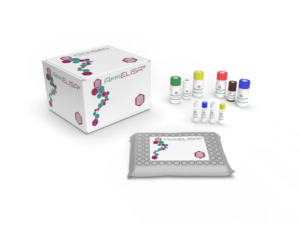
The Bovine Corticoliberin ELISA [CRH] kit is a highly specific and sensitive assay designed for the detection and quantification of Corticotropin-Releasing Hormone (CRH) in bovine samples. CRH plays a crucial role in regulating the hypothalamic-pituitary-adrenal (HPA) axis, influencing the body’s response to stress. The availability of this ELISA kit allows researchers to better understand the role of CRH in bovine physiology and its impact on animal health and stress management.
What is Corticotropin-Releasing Hormone (CRH)?
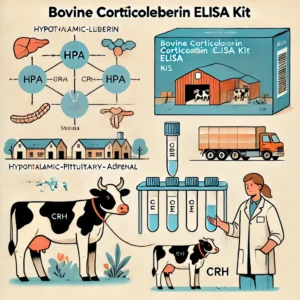
CRH is a peptide hormone produced primarily in the hypothalamus, responsible for stimulating the release of adrenocorticotropic hormone (ACTH) from the anterior pituitary. This release, in turn, leads to the secretion of glucocorticoids from the adrenal glands, which are critical in managing the stress response. Understanding the role of CRH in bovine species is important for research in animal physiology, veterinary medicine, and endocrinology. For further details on CRH’s role in stress response, you can visit the National Institutes of Health (NIH) and the National Library of Medicine (NLM).
Key Applications of Bovine Corticoliberin ELISA [CRH]
1. Stress Physiology in Cattle: The Bovine CRH ELISA kit is essential for studying the physiological response to stress in cattle. By measuring CRH levels in plasma or serum, researchers can assess how animals respond to various stressors, including transportation, handling, and environmental conditions. This research is critical for improving animal welfare and farm management practices. For more information on stress physiology in livestock, refer to resources from the United States Department of Agriculture (USDA) and Cornell University’s Animal Science Department.
2. Veterinary Endocrinology: CRH plays a central role in regulating the endocrine system. The ELISA kit allows veterinarians and researchers to evaluate adrenal and pituitary functions in cattle, helping in the diagnosis of endocrine disorders and stress-related illnesses. More about veterinary endocrinology can be found at Veterinary Information Network (VIN) and the American Veterinary Medical Association (AVMA).
3. Agricultural Research: Understanding how stress hormones like CRH affect cattle’s growth, reproduction, and immune function can lead to improved farming practices and better management of livestock. The Bovine CRH ELISA kit provides accurate, reproducible data essential for agricultural studies. The University of California, Davis College of Agricultural and Environmental Sciences offers more insights into agricultural research.
High Sensitivity and Specificity:
The Bovine CRH ELISA kit is designed for high sensitivity, allowing for the detection of low levels of CRH in serum or plasma samples. The kit uses specific antibodies that bind to CRH, ensuring precise measurement. To learn more about ELISA techniques, visit the National Center for Biotechnology Information (NCBI).
Fast and Easy Workflow:
The assay procedure is simple, with easy-to-follow protocols that allow for the processing of multiple samples in a short time. This makes it an ideal tool for laboratories conducting large-scale studies. Protocol optimization can be found at Johns Hopkins School of Medicine and Harvard University.
Wide Range of Applications:
In addition to its use in bovine research, this ELISA kit can be adapted for use in studies on other species, providing flexibility for comparative research in stress physiology. More about cross-species research is available from the National Institute of General Medical Sciences (NIGMS) and Princeton University’s Department of Molecular Biology.
CRH and the Hypothalamic-Pituitary-Adrenal (HPA) Axis
CRH is a major regulator of the HPA axis, which is responsible for controlling the body’s reactions to stress. By measuring CRH levels, researchers can assess the activation of the HPA axis under different conditions. For more information on the HPA axis, check out the National Institute of Mental Health (NIMH) and Stanford University’s Neurosciences Institute.
Enhancing Animal Welfare and Farm Management
The measurement of CRH levels through this ELISA kit is valuable in developing strategies to reduce stress in farm animals, which can improve overall health and productivity. Understanding how environmental and management factors influence CRH levels can lead to the implementation of better welfare practices in agriculture. For more on improving farm management practices, visit Purdue University’s College of Agriculture and the World Organization for Animal Health (OIE).
Conclusion
The Bovine Corticoliberin ELISA [CRH] kit offers a powerful and reliable tool for studying stress physiology and endocrinology in cattle. Its high sensitivity, ease of use, and broad application range make it indispensable for researchers and veterinarians alike. For more details on the kit and its applications, consult resources like the National Institute on Aging (NIA) and the University of Wisconsin-Madison Department of Animal Sciences.